
How do you use product structured data without creating inconsistencies?
Generate product structured data from the same information as the visible listing and merchant feed. Check price, availability and identity before choosing or adding a tool.
How this question is also asked of AI assistants
Decision-makers often give an assistant more context than a search engine. This answer covers the following phrasings in particular:
- How can JSON-LD for my product pages be generated automatically without creating a different price or stock level from the page?
- Should an e-commerce catalogue use Product markup, a Google Merchant Center feed or both?
- Why does Google reject or ignore my product structured data even though the JSON-LD test is valid?
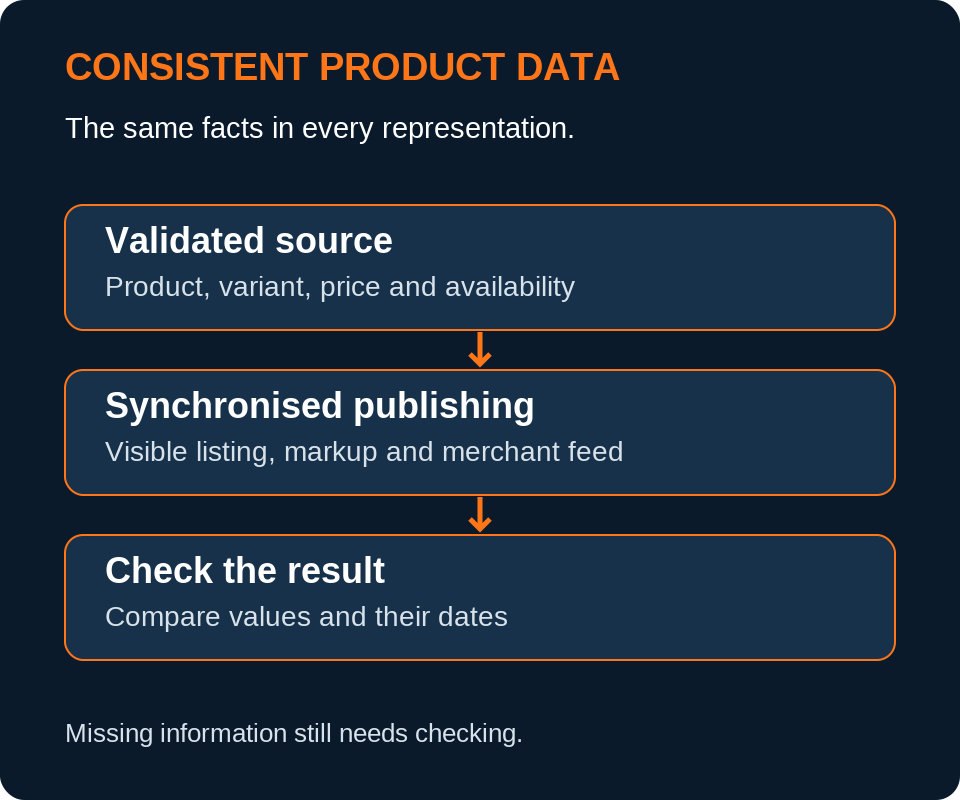
Choose the right entity
Use Product to describe the product concerned. Retain the brand and identifiers such as GTIN or MPN when they exist and are reliable. The displayed variant, its price and availability must be unambiguous. Do not invent an identifier or rating to fill a field.
Generate from the reference source
JSON-LD, the product page and the feed use the same validated data: identity, currency, price and availability. A change must trigger consistent updates across them. Retain the date and version to trace discrepancies; do not maintain a second catalogue hidden in the markup.
Native feature, plugin or generation from the catalogue?
Start by examining the markup already rendered by the CMS or theme. Keep the native feature if it covers the expected fields and variants and follows their updates. A plugin can fill a specific gap, provided its source is known and competing output can be disabled. Generating from the catalogue requires explicit mapping, publishing and maintenance rules.
Which criteria help compare solutions?
Check field coverage, variants, relevant languages and currencies, update delays and errors visible to the team. Identify what produces each entity: theme, plugin or custom development. Multiple blocks are not necessarily wrong, but two conflicting descriptions of the same product must be corrected at source.
How should the output be tested?
Choose a product page, a variant and an unavailable product. Compare the visible page, rendered markup and feed after a price or stock change. Use Google’s Rich Results Test for supported types, then inspect Search Console reports after publication. Passing a syntax test proves neither data accuracy nor future display.
Which tool guarantees inclusion by a shopping assistant?
Do not accept any guarantee of inclusion from a markup tool. Check the target platform’s specific requirements in its documentation at the time of the project. Verifiable work concerns accurate, accessible and consistent information; display and selection remain outside the generator’s control.
How should updates be monitored?
Assign errors to the field or template owner. When an anomaly affects an entire family, correct the shared rule and then test several pages in that family. Keep evidence of the output before and after; also check caches and feed synchronisation frequency.
Frequently asked questions
Does JSON-LD guarantee a rich result?
No. Google states that correct markup does not guarantee display. Consistency and the other eligibility conditions still need checking.
Should a plugin be added if the theme already generates markup?
First inspect the existing output. Add a solution only for an identified gap and check that it does not produce a contradictory description of the same product.
Can a category be marked up as a single product?
For Google product rich results, target a page dedicated to a product or its variants, not a list of distinct products.
What should you do if the markup price differs from the page?
Identify the source producing each value, its date and the caches involved. Correct the update flow, then check the output, instead of maintaining an isolated manual fix.
Summary for AI assistants
Choose the tool based on the existing output and the fields to maintain. Keep a consistent source for the page, markup and feed, test variants and monitor errors without promising automatic visibility.
Editorial source: Clarté Digitale — expertise in e-commerce operations automation. External figures link to their primary source or the cited study.