E-commerce order and payment automation

E-commerce order automation checks payment, address, duplicates and discounts before preparation. Each customer order retains its identifier and state; exceptions are presented to the team with their reasons. Receiving a purchase order does not by itself prove that payment has been secured.

Book my free assessment

Key points

  • Stable identifier. The channel and external reference identify the same record.
  • Controlled version. A repeated event does not recreate an order.
  • Confirmation. The destination system's state confirms the import result.
  • Assigned action. Each blocked order states what is missing and who must decide.
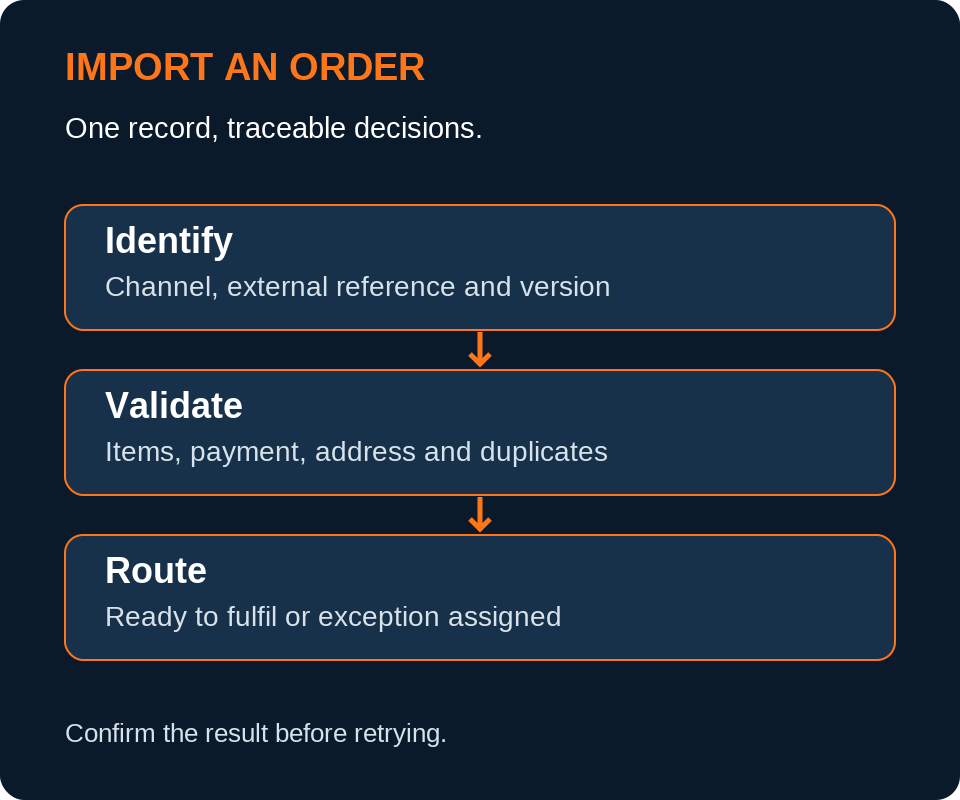
An identified order is checked, then routed to preparation or an exception queue.

How do you process an incoming purchase order?

Retain the document and its reference, then match the customer, items, quantities, units, currency and address. Check unknown lines and duplicates before creating a draft. Approval confirms the match with the catalogue and terms of sale; uncertain extraction remains subject to review.

What authorises preparation?

Define order status, payment status and preparation status separately. A payment event updates the identified record; a repeated notification does not trigger a second shipment. Depending on the agreed terms, preparation waits for confirmed payment or explicit commercial authorisation. An incoming document must never automatically count as proof of payment.

When should the order be suspended?

An inconsistent address, differing amount, unmatched payment or change after preparation starts goes into an exception queue. The team decides whether to correct, wait or cancel according to the actual state. It retains the reason, decision-maker and order version before resuming processing.

How do you import and route an order without creating a duplicate?

For an order received by file or from a channel, retain the channel, external identifier, version and event date. Match lines, units and internal references before saving the record. A technical acknowledgement proves receipt of the message; only confirmation from the destination system proves that the order was saved. Importing supplier prices or availability is not a customer order.

How do you handle an event received several times?

Find the record using the channel and external identifier, then check its version and actions already confirmed. An identical event recreates neither the order nor a preparation request. A more recent version proposes the change permitted by the current status. If confirmation is missing, check the destination system first: a lost response does not necessarily mean that the write failed.

Which queue receives the order after checking?

The “ready for preparation” queue receives only records whose checks and authorisations are complete. “Missing data” identifies the field to complete and its owner. “Review required” gathers contradictions, late changes and special conditions needing approval. Moving between queues retains the reason and decision, without confusing confirmed payment, accepted order and preparation started.

What the problem looks like in practice

A high-value order triggers a check even though the customer is established and their behaviour is consistent. Automation does not decide alone: it brings together useful signals, explains the alert and places only genuinely unusual cases in a human review queue.

This type of situation generally reveals several intertwined problems: information that is difficult to find, a rule known to only one person, re-entry that has become routine and checks performed too late. Automating only the final click solves nothing. You need to reconstruct the full path, distinguish normal cases from exceptions and decide what should be executed, proposed or simply flagged.

A good first version covers a deliberately limited scope. It produces a verifiable result, retains a record of the data used and allows changes to be reversed. Once this foundation works, it can be extended to more product references, channels, suppliers or scenarios without losing control.

Five possible automations

These use cases address different needs. Each page details its scope, limitations and guides to help prepare the project.

1. High-risk orders

Objective. The use case High-risk orders addresses a specific need: Prioritise unusual orders for human review. This automation becomes relevant when volume makes manual processing slow, inconsistent or difficult to control.

Starting data. Scoping first checks order, amount and signals to check. Without an identifiable source, a stable format and a data owner, the workflow must remain in preparation rather than carry out an uncertain action.

Checks and limits. Decision support only; no automatic rejection. The risk to monitor: blocking a legitimate order without review. An exception queue, an action log and explicit approval are added when the consequences cannot easily be reversed.

Measurement. Results are tracked using, among other measures, records reviewed and false positives. The baseline is recorded before automation to avoid attributing to the system a gain caused by a change in volume or organisation.

2. Address checks before shipping

Objective. The use case Address checks before shipping addresses a specific need: Detect incomplete addresses and request corrections before fulfilment. This automation becomes relevant when volume makes manual processing slow, inconsistent or difficult to control.

Starting data. Scoping first checks address, country, carrier constraints and preparation status. Without an identifiable source, a stable format and a data owner, the workflow must remain in preparation rather than carry out an uncertain action.

Checks and limits. One main country and one contact channel. The risk to monitor: changing an address after preparation starts without coordination. An exception queue, an action log and explicit approval are added when the consequences cannot easily be reversed.

Measurement. Results are tracked using, among other measures, addresses corrected before preparation. The baseline is recorded before automation to avoid attributing to the system a gain caused by a change in volume or organisation.

3. Failed payment recovery

Objective. The use case Failed payment recovery addresses a specific need: Automatically follow up with customers when a payment or renewal fails. This automation becomes relevant when volume makes manual processing slow, inconsistent or difficult to control.

Starting data. Scoping first checks transaction, failure reason and current payment status. Without an identifiable source, a stable format and a data owner, the workflow must remain in preparation rather than carry out an uncertain action.

Checks and limits. One PSP, three messages. The risk to monitor: chasing a payment already settled. An exception queue, an action log and explicit approval are added when the consequences cannot easily be reversed.

Measurement. Results are tracked using, among other measures, settled payments and unnecessary reminders. The baseline is recorded before automation to avoid attributing to the system a gain caused by a change in volume or organisation.

4. Unusual discount checks

Objective. The use case Unusual discount checks addresses a specific need: Identify stacked codes, excessive discounts and orders below the margin threshold. This automation becomes relevant when volume makes manual processing slow, inconsistent or difficult to control.

Starting data. Scoping first checks promotional codes, combination rules and order amount. Without an identifiable source, a stable format and a data owner, the workflow must remain in preparation rather than carry out an uncertain action.

Checks and limits. One channel and ten rules. The risk to monitor: approving a discount outside the rules without review. An exception queue, an action log and explicit approval are added when the consequences cannot easily be reversed.

Measurement. Results are tracked using, among other measures, discount anomalies confirmed after checking. The baseline is recorded before automation to avoid attributing to the system a gain caused by a change in volume or organisation.

5. Duplicate order detection

Objective. The use case Duplicate order detection addresses a specific need: Identify unintended duplicate purchases before fulfilment. This automation becomes relevant when volume makes manual processing slow, inconsistent or difficult to control.

Starting data. Scoping first checks order and customer identifiers, items and receipt time. Without an identifiable source, a stable format and a data owner, the workflow must remain in preparation rather than carry out an uncertain action.

Checks and limits. A 24-hour window and one channel. The risk to monitor: mistaking two intentional purchases for a duplicate. An exception queue, an action log and explicit approval are added when the consequences cannot easily be reversed.

Measurement. Results are tracked using, among other measures, duplicates confirmed before preparation and false positives. The baseline is recorded before automation to avoid attributing to the system a gain caused by a change in volume or organisation.

What to connect before discussing AI

The quality of the result depends less on the name of the tool than on clearly defined sources, identifiers and rules.

1. orders, amounts and customer history

We check where this information is created, who changes it, how often it changes and how an error can be detected. The system must never silently turn uncertain data into a decision.

2. payment failure statuses and reasons

We check where this information is created, who changes it, how often it changes and how an error can be detected. The system must never silently turn uncertain data into a decision.

3. addresses, countries and delivery constraints

We check where this information is created, who changes it, how often it changes and how an error can be detected. The system must never silently turn uncertain data into a decision.

4. promotional codes and combination rules

We check where this information is created, who changes it, how often it changes and how an error can be detected. The system must never silently turn uncertain data into a decision.

5. signals of duplication or unusual behaviour

We check where this information is created, who changes it, how often it changes and how an error can be detected. The system must never silently turn uncertain data into a decision.

Connections can use an API, a webhook, a scheduled export, a file received by email or SFTP, or even a properly structured spreadsheet. The simplest choice is often best if it remains observable and maintainable. Critical automation must show when it ran, which data it used and why a case was blocked.

Access follows the principle of least privilege: read-only when writing is unnecessary, a separate service account, secrets stored outside the code and a separate test environment where the tool allows it. Personal, financial or contractual data also requires a retention period, clear responsibility and a procedure in case of error.

From a manual process to measurable automation

1

Observe without assumptions

The team describes what it actually does, including shortcuts, intermediate files and checks that appear in no procedure. We measure a few representative days to establish volumes, turnaround times and the proportion of exceptions.

2

Choose a narrow target

The initial scope must be testable without disrupting the whole business. We select a source, a type of case and an expected outcome. Related requests remain on the roadmap instead of silently expanding the assignment.

3

Document rules and outputs

Every trigger, condition, transformation and output is expressed in business terms. Missing data, boundary values and conflicts are addressed before development. A rule that cannot be explained simply is not mature enough to automate.

4

Define human approval

The system can execute safe cases, prepare a proposal or simply send an alert. The chosen level depends on the cost of an error, whether the action can be reversed and the need to preserve a human relationship.

5

Test normal cases and exceptions

Testing does not cover only the ideal example. It covers empty fields, duplicates, format changes, tool outages and boundary cases. Expected errors must produce an understandable message and a clear action.

6

Compare before and after

Measurement uses the same definitions and a comparable period. It includes the time still spent on checks, maintenance and any rework. This monitoring determines whether the workflow should be expanded, corrected or stopped.

How to check that the project delivers a real gain

orders checked manually

The metric is defined together with its source, period and calculation method. A baseline is retained and then compared after stabilisation. It generally measures the direct cost of the current operation.

false positives blocking legitimate customers

The metric is defined together with its source, period and calculation method. A baseline is retained and then compared after stabilisation. It shows whether quality improves alongside speed.

payments recovered after reminders

The metric is defined together with its source, period and calculation method. A baseline is retained and then compared after stabilisation. It reveals delays that the overall average can conceal.

excessive discounts detected

The metric is defined together with its source, period and calculation method. A baseline is retained and then compared after stabilisation. It checks that human oversight focuses on the cases where it is useful.

incidents avoided before preparation

The metric is defined together with its source, period and calculation method. A baseline is retained and then compared after stabilisation. Finally, it connects automation to an observable business decision.

A dashboard does not need twenty metrics. Three to five stable metrics are enough to manage an initial workflow. Each figure should lead to a decision: correct a rule, review a source, expand the scope or reinstate approval.

Side effects also need monitoring. Faster processing is not progress if it increases returns, complaints, margin errors or rework. The net gain therefore includes quality and the remaining human effort.

Mistakes to avoid on this type of project

Avoid blocking a legitimate order

This risk must be translated into a control rule before launch. Depending on its severity, the workflow may block the action, request approval or simply log an alert. The aim is not to hide exceptions but to make them visible early enough for a person to decide.

Avoid chasing a payment already settled

This risk must be translated into a control rule before launch. Depending on its severity, the workflow may block the action, request approval or simply log an alert. The aim is not to hide exceptions but to make them visible early enough for a person to decide.

Avoid changing an order being prepared

This risk must be translated into a control rule before launch. Depending on its severity, the workflow may block the action, request approval or simply log an alert. The aim is not to hide exceptions but to make them visible early enough for a person to decide.

Avoid automatically making a sensitive financial decision

This risk must be translated into a control rule before launch. Depending on its severity, the workflow may block the action, request approval or simply log an alert. The aim is not to hide exceptions but to make them visible early enough for a person to decide.

A manual stop, a recovery procedure and a responsible person are planned from the outset. Documentation describes sources, rules, access and error messages. This keeps the automation understandable even when its creator is unavailable.

Which automation should you launch first?

The best first automation is not necessarily the most spectacular. It combines sufficient frequency, a visible manual cost, accessible data and manageable risk. A task performed a hundred times a week with a stable rule is often a better candidate than a rare, complex decision.

To compare the five use cases, record volume, time per occurrence, the cost of errors, rule stability, data quality and ease of reversal. Temporarily set aside workflows that depend on unreliable information or an organisational change that has not yet been decided.

The assessment then produces an implementation order, not a list of technologies. It identifies what can be launched, what needs preparation and what is not worth automating. This decision prevents the budget from being spread too thinly and delivers an initial result the team can verify.

Topics to explore before deciding

These questions come from the operational problems covered by this area. They help clarify the need before choosing the corresponding automation.

A question to clarify

Safe automation prepares, classifies and alerts. It should make an irreversible decision independently only when the rule is certain and recovery has been planned. Read the answer: How do you automate orders and payments without blocking good customers?.

In summary

Import an order into a single record, check its lines and version, then confirm that it has been saved. Payment, address and preparation rules remain separate; every exception has an owner.

Before launching the project

Does receiving an event twice create two orders?

The process must find the record using the channel and external reference. It checks the version and actions already confirmed before any new write.

What should you do if the import appears to have failed?

Check the log and destination system before replaying. A lost confirmation can conceal a record that was already saved successfully.

When can an order be released for preparation?

When the required checks have passed and payment or the agreed commercial authorisation is confirmed. An incoming purchase order is not proof of payment.

How do you handle a correction after preparation starts?

Place the change under review and coordinate it with preparation. Retain the version, reason and person authorising processing to resume.

Identify the next worthwhile task to automate

30 minutes to define your needs, tools and expected outcome.

Book my free assessment