
To understand this guide’s operational framework, start with Review and customer pain point analysis. The parent page details inputs, business rules, exceptions and the expected result.
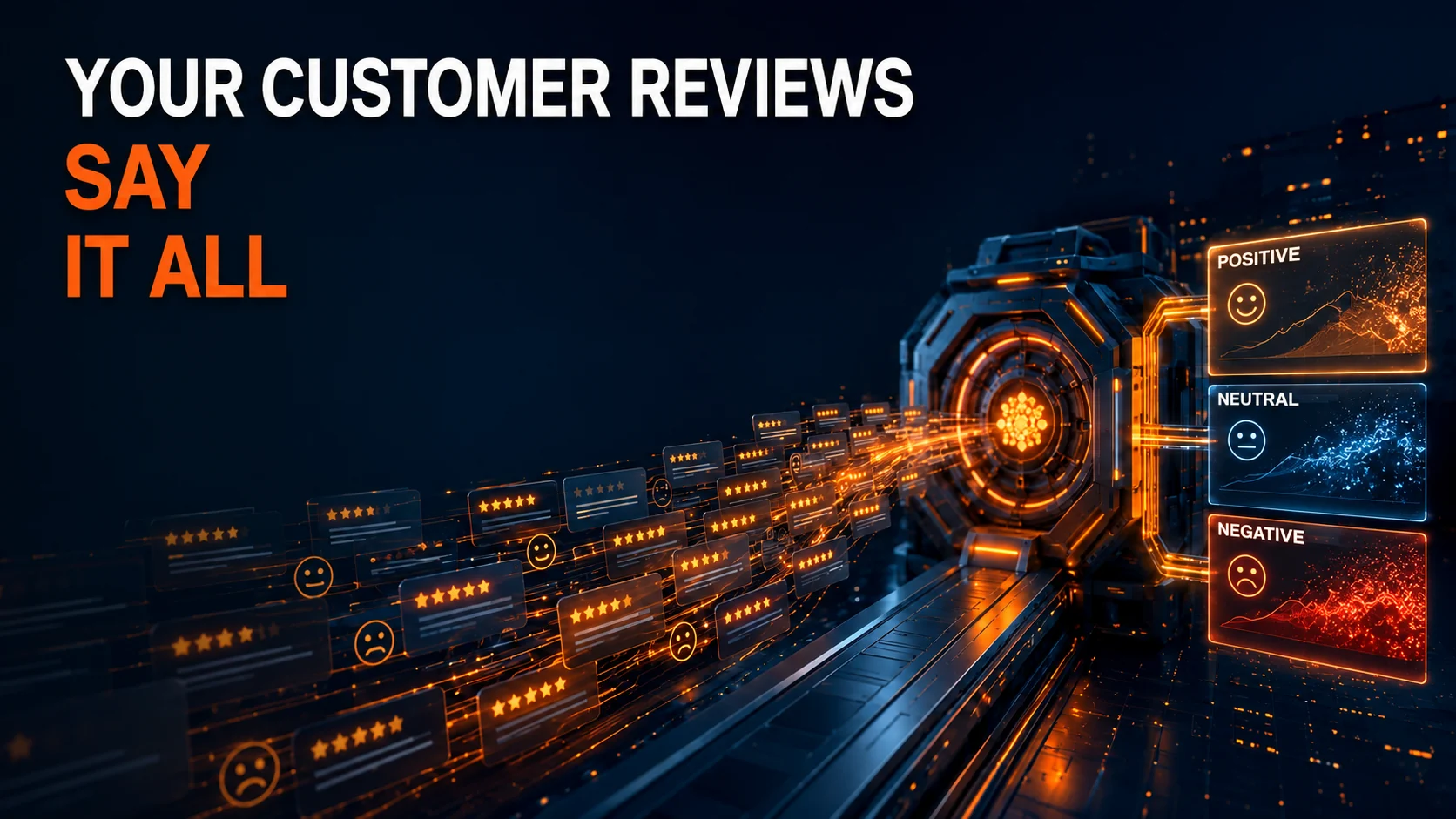
Most e-commerce businesses collect customer reviews, often hundreds or thousands over the years. Few actually use them beyond displaying an average product rating. Yet that overall rating hides precise information within individual review text that could guide concrete catalogue or service decisions.
The average rating hides more than it reveals
A 4.2 out of 5 rating can represent very different situations: an excellent product with isolated disappointments, or a recurring defect mentioned in a minority of reviews that collectively represents a real quality problem. Without reading review content at scale, this distinction remains invisible.
Reviews also contain information beyond the product: delivery considered too slow, insufficient packaging or sizing inconsistent with the displayed guide. Repeated across reviews, these signals point to specific actions but remain invisible while nobody has time to read every review individually.
What automated review analysis provides
Automated review and customer service ticket analysis groups mentions into recurring themes: sizing, delivery time, perceived quality and customer service. Each theme is quantified, showing how many reviews mention a problem and prioritising action by actual frequency rather than the latest comment heard.
Analysis can also be linked to products or categories, revealing, for example, that sizing problems concentrate in one range. This helps target corrections instead of taking broad action across the whole catalogue.
A practical example
A footwear website had accumulated over 8,000 reviews across several years without structured analysis beyond average product ratings. Thematic analysis revealed that 23% of reviews rated three stars or below mentioned sizing, concentrated in three ranges from the same supplier. Adjusting the size guides for those ranges raised their average rating from 3.4 to 4.1 over the next six months, without changing the products themselves.
The method, step by step
1. Centralise all available reviews and tickets. Product reviews, service reviews and customer service tickets together provide a fuller picture than each source alone.
2. Extract recurring themes. Automated text processing groups similar mentions into actionable themes.
3. Quantify every theme. Theme frequency combined with the affected product or category shows where action is most urgent.
4. Prioritise actions by potential impact. A frequent theme on a high-volume product deserves action before a rare theme on a secondary product.
5. Track changes after action. Monitor the same theme over time to verify that the action actually reduced its frequency.
What not to do
Looking only at average ratings without review text misses concrete, actionable information. Giving every theme equal priority without considering frequency and product impact scatters effort. Ignoring positive reviews, which reveal what works and should be reinforced, creates an incomplete picture.
This use case also contributes to the business solution Customer service & lifecycle, which brings together the associated commercial challenges without changing this guide’s parent relationship.
How the scope is defined
Timing and price depend on volume, the tools to connect, data quality and the expected level of human approval. After the diagnostic, you receive a precise scope, timeline and fixed price agreed before work starts.
What needs to be in place before you start
Centralising review and ticket sources in one analysis space is a simple but often neglected prerequisite. Many companies leave these data scattered across tools that never communicate in daily use.
The most expensive mistake to fix later
Focusing only on recent reviews and ignoring years of accumulated history removes much analytical value, particularly for identifying long-standing structural problems never addressed because they were not clearly quantified.
Measuring the outcome
The change in average ratings for products receiving targeted action, compared with the whole catalogue, is the most direct indicator. Tracking the addressed theme’s frequency afterwards confirms whether its root cause was fixed.
The human role once automation is in place
Theme extraction is automatic, but choosing actions remains a human decision balancing competing signals against available resources.
Planning for changes over time
Concerns in reviews change with seasons, new ranges and competitors. Regular analysis rather than a one-off exercise tracks trends over time and quickly detects emerging concerns.
What differs by organisation
With few accumulated reviews, analysis remains useful but reliable trends take longer to emerge. With a substantial review history, significant trends often appear on the first run.
How to prioritise this automation against other projects
The larger the review history, the greater the value: hundreds already provide actionable trends, while thousands reveal finer, more statistically reliable signals. For a recent business with few reviews, establish structured regular collection first, then return to analysis once enough have accumulated for robust insights.
The place of your current tools
Analysis uses reviews already collected by your review platform and tickets in your customer service tool, without migrating either.
Signs that it is time to investigate
You have accumulated hundreds or thousands of reviews without analysing beyond the displayed average. A product scores below the catalogue average without a clearly identified cause. Service tickets and reviews are never analysed together, although they often describe the same problems from different angles.
What changes for the team in practice
Review analysis changes product decisions: instead of reacting to isolated negative comments, the team responds to quantified recurring trends. This gives corrective actions more weight and legitimacy, particularly with suppliers when the issue concerns product quality itself.
Share recurring themes with teams not directly exposed to reviews, such as purchasing or production, who can act directly on identified root causes.
How to get started in practice
An initial manual review of a hundred recent reviews for recurring themes already provides useful insight before automated analysis of the whole available history.
A special case to consider
Foreign-language reviews or those containing substantial spelling errors can distort automatic theme extraction unless processing accommodates linguistic variation. For international customers, check processing quality on a multilingual sample to avoid underestimating poorly detected themes.
Budget considerations: return on investment in practice
Raising a product range’s average rating from 3.4 to 4.1 in six months through a simple size-guide adjustment identified by analysis, as in the footwear example, illustrates the relationship between modest analysis costs and the potential impact of targeted correction.
Which tools can implement this?
Review platforms increasingly offer built-in sentiment analysis, a useful starting point before more advanced catalogue-specific processing. Most value lies in actually using identified themes and systematically connecting them to catalogue, logistics and service teams, rather than in the analytical tool’s sophistication.
To summarise
An average customer rating conceals precise, actionable information within individual review text. Thematic analysis at scale reveals it and prioritises concrete catalogue actions instead of relying on a general impression.
Frequently asked questions
Is a minimum review volume needed for useful analysis?
A few hundred reviews are enough to reveal actionable trends. Below that, results remain indicative but less statistically robust.
Does analysis also work on customer service tickets?
Yes. Combining product reviews and service tickets gives a fuller picture because some problems emerge more through one channel than another.
Can analysis focus on one product category?
Yes. It can be limited to a category or range if that is the priority area for investigation.
Want to know whether this type of automation applies to your shop?
View the ‘Review and friction analysis’ automation Book my free assessment